
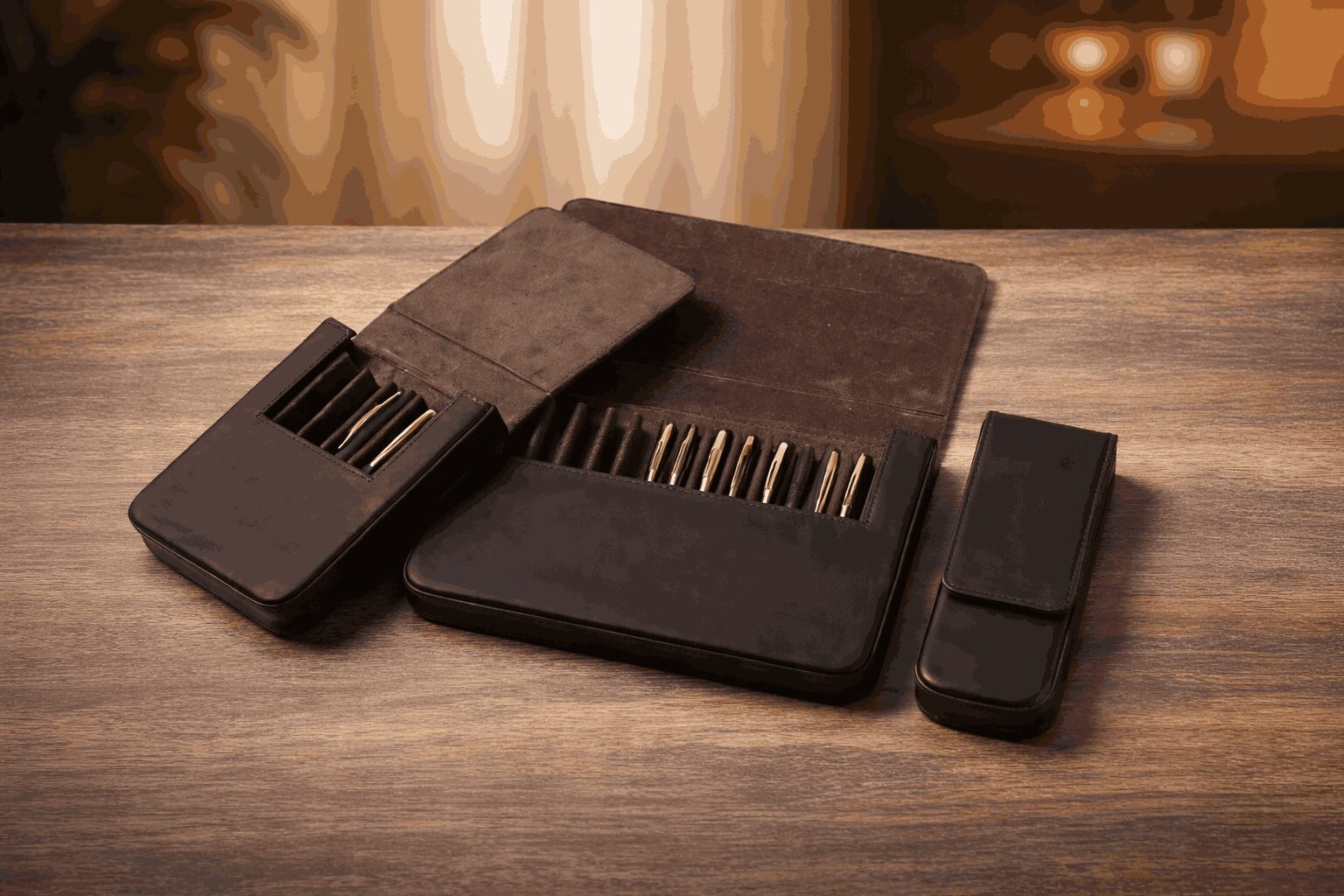
Concrete answer first: for most people who write every day, a six-pen case is the most efficient and least frustrating choice.
A two-pen case only works when your writing habits are rigid and predictable. A large everyday set only makes sense if writing or drawing is a core part of your daily work, not an occasional task.
Choosing pen case capacity is not about collecting pens. It is about removing friction during the day. The wrong size forces decisions at the worst moments.
The right size disappears from your thinking entirely.
Two-Pen Case: Precision Over Flexibility
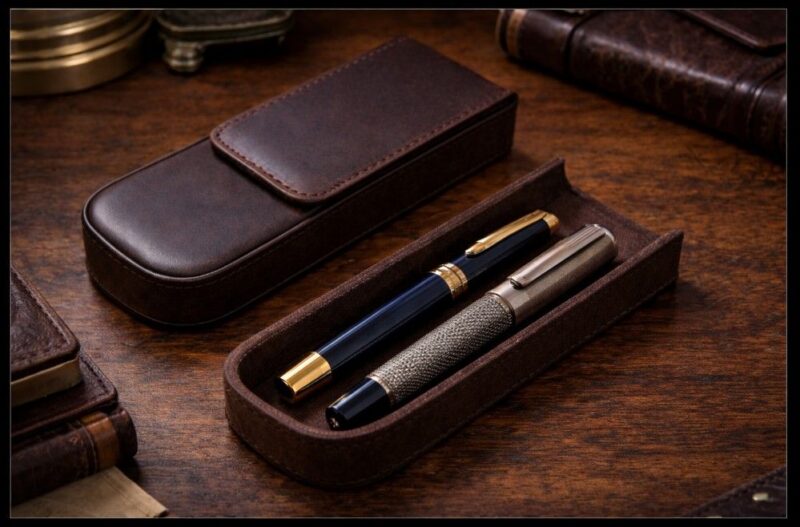
A two-pen case is a narrow solution for a narrow routine. It assumes you already know exactly how you write and that this does not change.
In real use, a two-pen case typically holds one primary pen and one backup or contrast pen. That contrast might be a different ink color or a different nib feel, but it does not expand capability in a meaningful way. It only adds redundancy.
This setup works well for people who mainly sign documents, write short notes, or rely on a single trusted pen model. It also works when the main notebook already includes a pen loop, and the case exists purely as insurance.
| Aspect | Real Outcome |
|---|---|
| Daily flexibility | Very low |
| Pocket friendliness | Excellent |
| Tool redundancy | Minimal |
| Meeting readiness | Limited |
| Best for | Fixed routines, signatures, minimal notes |
Six-Pen Case: The Everyday Sweet Spot
A six-pen case solves most real writing problems before they appear. It allows role separation between tools instead of forcing one pen to do everything.
In daily use, a six-pen leather pencil case usually supports one primary pen, one backup of the same type, one contrasting ink, one pencil or mechanical pencil, and one marking tool. This combination handles writing, editing, outlining, and quick corrections without hesitation.
The strength of this capacity is balance. It offers flexibility without encouraging excess. You gain redundancy where it matters and variety where it improves clarity.
For office work, studying, journaling, and general creative tasks, six pens cover nearly all practical needs. People who feel constantly underprepared with a six-pen case usually have not defined roles for each pen, not a capacity problem.
| Aspect | Real Outcome |
|---|---|
| Daily flexibility | High |
| Bag compatibility | Easy |
| Tool switching | Fast |
| Clutter risk | Low |
| Best for | Office work, study, and everyday writing |
Full Everyday Set: Capability With a Cost
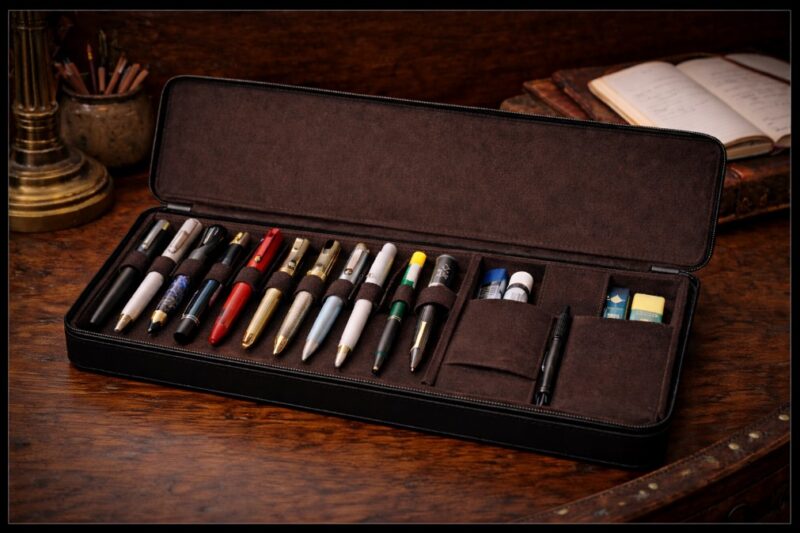
Large pen cases, usually holding ten or more tools, are not wrong. They are simply specialized.
In real life, a full everyday set functions like a portable desk drawer. It supports multiple nib sizes, color systems, drawing tools, and correction options. This is valuable only when those tools are actively used throughout the day.
Designers, illustrators, technical students, and heavy journal users often benefit from this capacity because their output depends on variation. Writers who work long sessions away from a desk may also justify it.
| Aspect | Real Outcome |
|---|---|
| Daily flexibility | Very high |
| Portability | Moderate to poor |
| Access speed | Slower |
| Overpacking risk | High |
| Best for | Design, long writing sessions, and color systems |
Capacity vs Reliability
One overlooked factor is pen reliability. People often increase their capacity to compensate for pens they do not trust.
When ink flow is inconsistent or pens dry out, users carry extras “just in case.” When pens are reliable, capacity naturally shrinks.
A smaller case with dependable tools outperforms a large case filled with uncertainty.
Capacity should follow trust, not replace it.
How Case Material Changes Real Capacity (And Why It Matters)
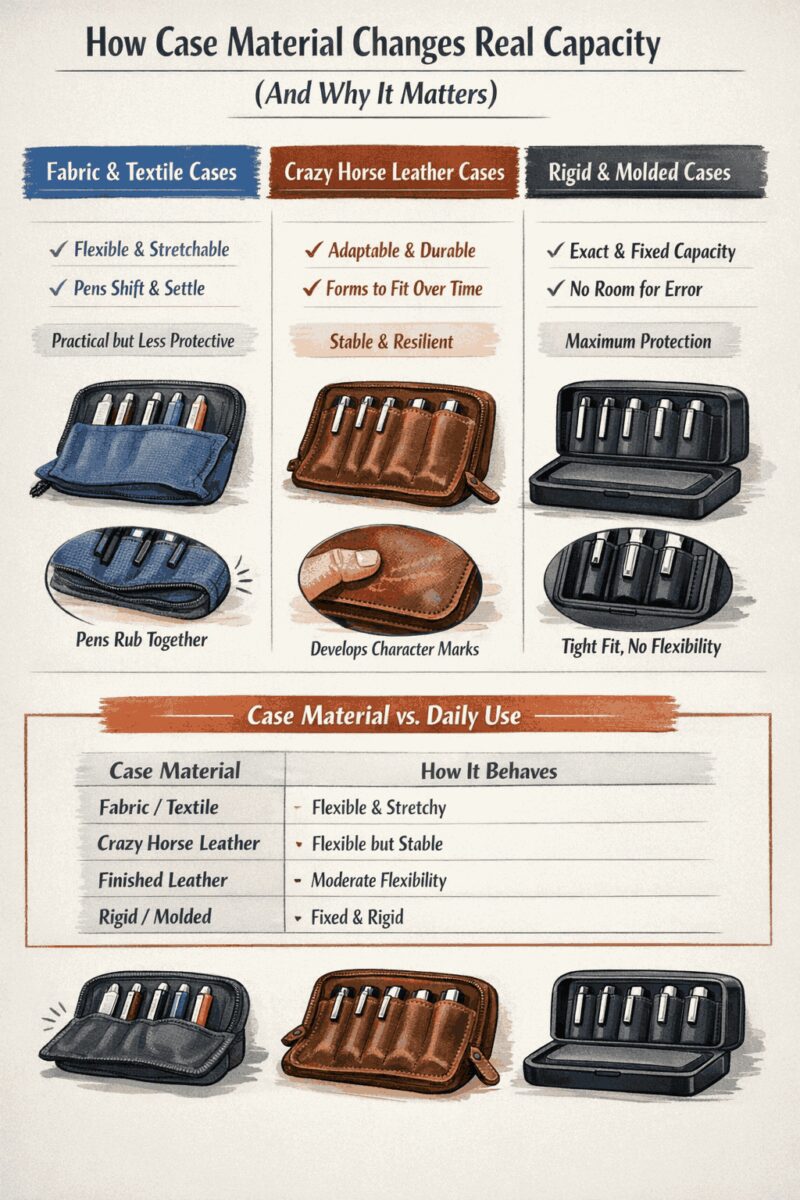
Capacity on paper is not the same as capacity in use. Material determines how a pen case behaves once it is filled, carried, opened, and compressed inside a bag.
Two cases labeled for the same number of pens can feel completely different after a week of use.
Soft materials adapt. Rigid ones enforce limits. Leather sits somewhere in between, depending on how it is finished.
Fabric and Soft Textile Cases
Fabric cases stretch slightly and forgive uneven pen sizes. They accept thicker barrels, clips, and small accessories without complaint. This makes them practical, but also less protective.
Over time, fabric cases tend to sag. Pens settle into each other, which can lead to cosmetic wear if you carry metal pens or sharp clips.
They work well for casual use, but they do not preserve structure.
Crazy Horse Leather Cases
Crazy horse leather behaves very differently from standard finished leather.
It is a full-grain leather treated with waxes, not coatings. Because the grain layer is left intact, the leather flexes instead of cracking. It stretches subtly over time, then stabilizes. That matters for capacity.
In real use, a crazy horse leather case marked for six pens often accommodates slight variation in barrel thickness without stressing seams. It does not feel loose, but it does not fight you either.
The leather develops surface marks from daily handling, but these are cosmetic. They do not weaken the structure.
Basic maintenance is minimal – occasional conditioning and dry wiping are usually enough to preserve flexibility and surface stability over years of daily use.
Wax treatment allows the leather to compress and rebound repeatedly without fiber damage.
This makes crazy horse leather especially well-suited for daily carry pen cases, where the case is opened often, flattened in bags, and pressed against other objects.
Structured and Rigid Cases
Rigid cases, including molded leather or synthetic shells, enforce exact limits. They protect pens well, but they do not forgive mistakes.
If the case is rated for six pens, six pens is the absolute maximum. Clips that sit awkwardly or pens with wider barrels create pressure points. Over time, this leads to seam stress or warped closure lines.
These cases are best when protection is the priority and pen selection is consistent.
| Case Material | How It Behaves in Daily Use |
|---|---|
| Fabric or textile | Flexible, stretches easily, low structure |
| Crazy horse leather | Flexible but stable, adapts without weakening |
| Standard finished leather | Moderate flexibility, depends on coating |
| Rigid or molded cases | Fixed capacity, no tolerance for overload |
Conclusion
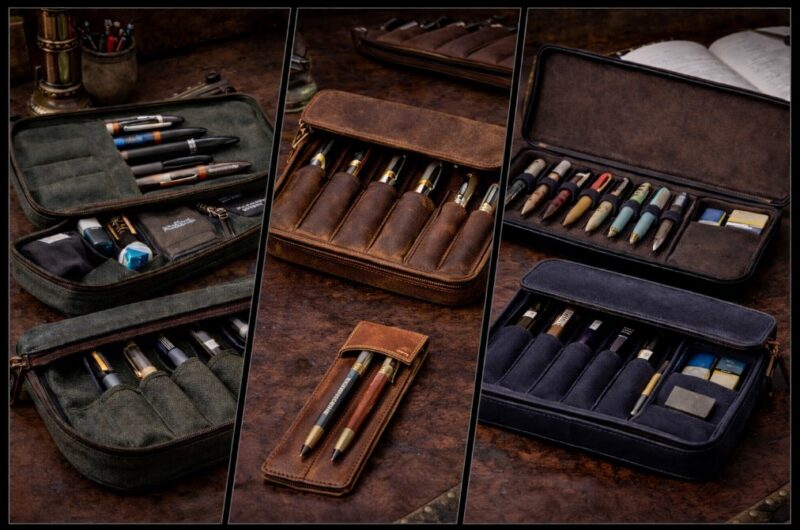
Choosing the right pen case capacity comes down to how you actually work, not how you think you should work.
If your writing tasks are short and predictable, a two-pen case can be enough. It stays out of the way and does its job, as long as nothing unexpected happens. The moment your day requires structure, annotation, or switching tools, its limits become obvious.
For most people, a six-pen case strikes the right balance. It supports different writing roles without adding weight or distraction. You are prepared for changes in task or context, but you are not managing excess. That is why it feels effortless in daily use.
A full everyday set earns its place only when variation is essential to your output. If multiple tools are actively used every day, the size makes sense. If they are not, the case becomes friction instead of support.