

Ask most men what makes a gentleman and you will get a list: which fork, which glass, who walks on the street side, who pays. The list is long, the anxiety real, and nearly all of it misses the point. A gentleman is not the man who has memorized the most rules; he is the man other people feel relaxed around. Everything else is detail.
That is truer than it used to be, because the old markers of class have gone quiet. In its October 2024 survey of how Americans judge men’s behavior, the Pew Research Center found exactly one item more people rated highly acceptable than highly unacceptable: putting real effort into style and fashion (42 percent versus 15 percent). Heavy drinking, casual sex, and old-fashioned toughness all drew majority disapproval. Class is no longer inherited; it is performed in real time, in a greeting, a doorway, a dinner. The good news is that it can be learned.
The first ten seconds happen before you speak
Start with the handshake – the piece of etiquette researchers have actually studied. In a 2000 study in the Journal of Personality and Social Psychology, 112 volunteers each shook hands with four trained coders; firm handshakes tracked with extraversion and emotional expressiveness, and away from shyness and neuroticism. A later study in the Journal of Applied Psychology found that handshake quality in mock job interviews predicted hiring recommendations even after the researchers controlled for dress and appearance. A damp, limp grip is not a minor embarrassment; it is a data point about you, read in under three seconds.
The fix is mechanical. Stand to greet someone who approaches, meet web-of-hand to web-of-hand, squeeze with conviction but never hard enough to crush, hold eye contact, and release after a couple of pumps. And keep your phone out of the hand you offer: nothing undercuts a greeting like half a palm while the other thumb scrolls.

The fork was the scandal before you were
Table manners are where otherwise confident men feel like impostors – which is funny, because today’s sacred rules were once themselves an outrage. The fork reached Venice in the eleventh century with a Byzantine bride, Maria Argyropoulina, and a scandalized clergyman declared that God had provided natural forks, human fingers, and that eating with metal was an insult to Him. For centuries afterward the fork was mocked across Europe as effeminate fussiness – a saga National Geographic traced in 2025, and a useful antidote to dinner-table panic. Manners change; etiquette is one long parade of yesterday’s outrages becoming today’s essentials.
That history runs straight into the question every man actually asks at a formal dinner: American or Continental? Emily Post coined the term “zigzag” in 1928 for the American habit of switching the fork to the right hand after cutting and called it “a ridiculous practice of the would-be elegant.” Her heirs later conceded it is “perfectly correct.” Economists still argue over how Americans adopted it at all: Travis Lybbert, writing in Economic Inquiry in 2010, traced the zigzag to British mercantilist taxes that made forks a colonial luxury, so early Americans learned to eat with knife and spoon and kept switching once forks arrived.
A short history of the fork in four lines
| When | What happened |
|---|---|
| 11th century | A Byzantine bride scandalizes Venice by eating with a golden fork; clergy call it an insult to God |
| c. 1608 | Thomas Coryate brings the fork back to England from Italy and is mocked for his fussiness |
| 1928 | Emily Post derides the American “zigzag” as a ridiculous practice of the would-be elegant |
| 2010 | Economist Travis Lybbert links the zigzag to British mercantilist taxes on colonial tableware |
Every serious guide today accepts both styles, so the only actual rule is to pick one, perform it without thinking, and never comment on anyone else’s method. Class at the table is fluency and grace, not fork-correctness.
Phones down, wine poured, the bill settled
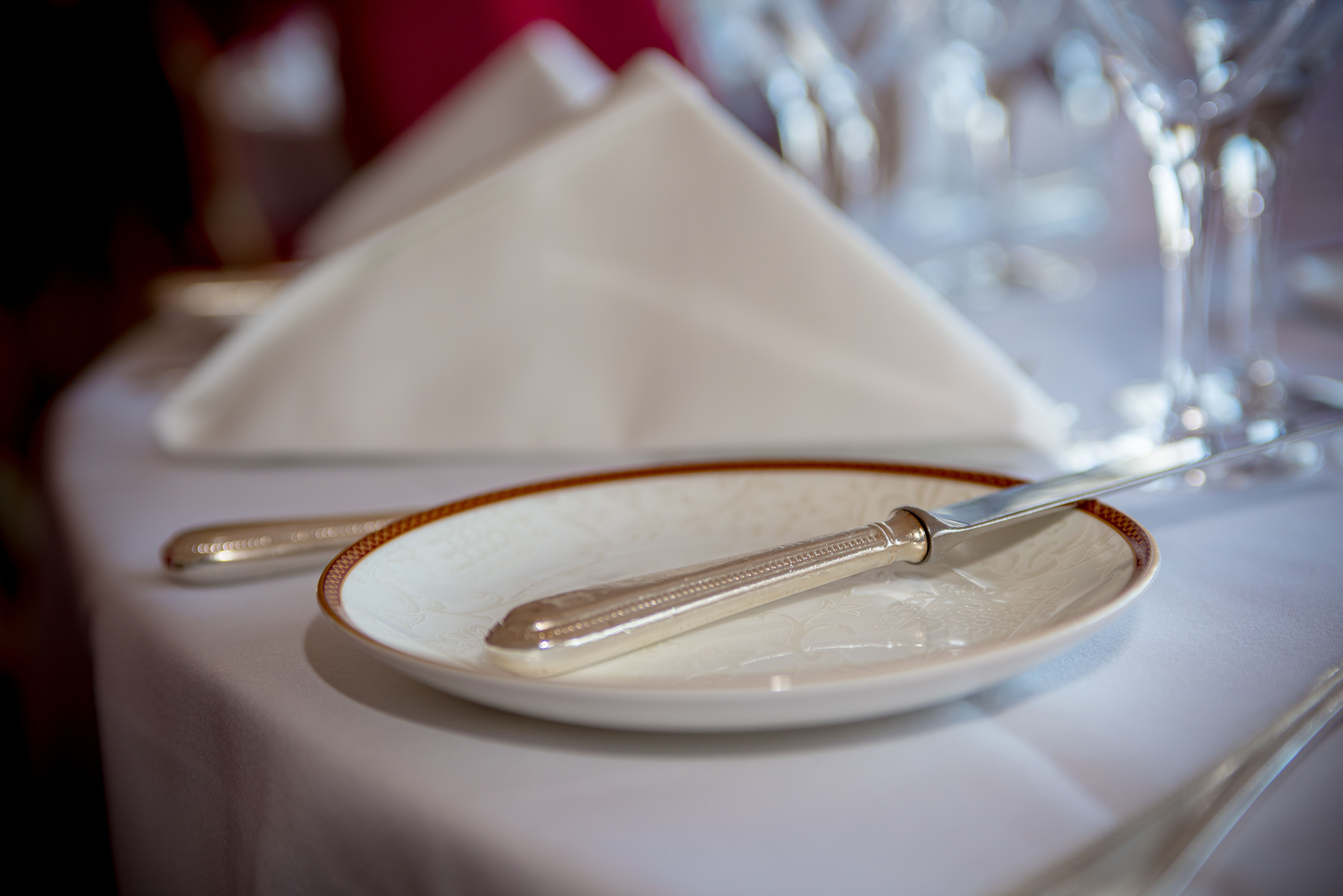
The modern dinner’s real enemy is not the fork but the phone. In a 2020 survey commissioned by British leather house Maxwell-Scott, 80 percent of respondents said impeccable manners remain the most important quality in a gentleman, and 59 percent said a gentleman keeps his phone off the table while dining. The highest-leverage habit in modern manners is nearly free: phone on silent and out of sight, and if a call cannot wait, excuse yourself and take it away from the table.
On wine, err toward attention rather than arcana. Pour for others before yourself; and when someone raises a toast to you, do not drink – you are the subject, not a participant. Smile, meet their eyes, and answer with a short toast of your own.

On the bill, the rule has not changed: whoever issued the invitation pays. Prefer to split? Say so before ordering, cheerfully, and never renegotiate at the table. And do not mistake the modern gentleman for one who has dropped the small chivalries – a January 2026 Yahoo News/YouGov poll found 83 percent of women under 45 still consider chivalry important. Open the door, offer the jacket, take the street side: offer once, and accept a “no, thank you” with the same grace you would accept a yes. The offer is the courtesy; the insistence is not.
Formal events: be easy to host and easy to have
Two reputations matter at any formal occasion: yours as a guest and yours as a host. As a guest, the unglamorous rules win the evening: RSVP by the date, never bring a plus-one the host did not invite, and send a short thank-you within a couple of days – handwritten if you can manage it. In the room, circulate rather than camping by the bar, and use a new acquaintance’s name once early in the conversation; people love their own names. When you need to exit a conversation, the line that never fails is, “Please excuse me – I owe the host a hello.”
As a host, one skill outranks every other: the introduction with a hook. “This is Marcus – he just got back from Tokyo” gives two strangers something to talk about; “This is Marcus” strands them. Greet everyone at the door, and make sure nobody spends the evening orbiting the room alone.
The company you keep
The surest measure of a gentleman at any event is how his guest is faring. Introduce your guest by name, keep them inside the conversation rather than leaving them to study the canapés, and notice when they have had enough. That standard applies to whoever you bring – a colleague, a date, a long-term partner.
It also applies to the guest many men quietly arrange when they would rather not attend an evening alone. Professional companionship has lost much of its old stigma, and an escort such as Louisa is chosen precisely because she is polished, discreet company for dinners, galas and travel. None of that changes your manners by a degree: she is your guest. Introduce her properly, include her, and treat her exactly as you would anyone you are proud to be seen with. Rooms remember the man whose guest felt honored; they forget the man whose guest was ignored.
The rule that makes every other rule optional
Not everyone buys the flexible approach, and the skeptic deserves a hearing. Judith Martin – Miss Manners herself – has spent decades warning that when formal rules dissolve into “whatever feels right,” what follows is often plain rudeness. She is right that codified etiquette removes guesswork and protects people too polite to complain. But rules are scaffolding, not scripture; they change, as the fork’s four-century journey proves. What endures is attention. When you slip – and you will – the recovery matters more than the mistake: smile, apologize briefly, move on. No one remembers a wrongly held fork. Everyone remembers whether you made them feel at ease. Be the man who does that, and you will be called a gentleman in any room, in any era, with no list of rules required.