

Curiosity about IQ never really goes away. A quick score can feel like a shortcut to an answer about how your mind works. The problem is that online IQ quizzes vary wildly in quality.
Some are serious practice tools built by organizations with a real testing background. Others are little more than puzzle games with a score slapped on top.
Mensa itself makes a clear distinction between online practice tools and properly supervised qualifying tests, while broader assessment guidance from APA and NCBI stresses standardization, controlled conditions, and careful interpretation.
So the best approach in 2026 is simple: use online quizzes for a useful signal, not a life verdict. A strong result can tell you that a formal test may be worth your time. A weak result can reflect fatigue, distractions, language load, or the quiz design itself.
Timed testing can also distort performance, especially when the task is supposed to measure reasoning rather than speed alone.
How I Chose the Top Picks
The ranking below favors quizzes that do at least one of four things well:
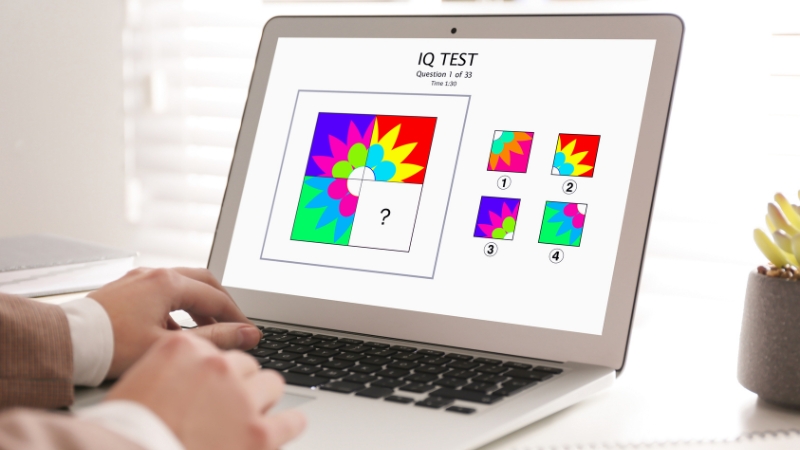
Raven-style matrix tasks show up often on the list for a reason. Matrix reasoning has long been a staple of nonverbal cognitive assessment, and Raven’s Progressive Matrices remain widely used in research and educational settings.
Readers who like matrix-style logic and structured analytical exercises may also find Qui Si Risolve useful as a separate practice resource.
A Quick Look
| Rank | Quiz | Best For | What You Get |
| 1 | Mensa Online IQ Test (UK) | Closest thing to a serious online option | Adaptive score, membership-qualifying at the 98th percentile |
| 2 | Mensa Norway IQ Test | Best free matrix-based score check | Indicative IQ score from 85 to 145 |
| 3 | American Mensa Practice Test | Best for testing Mensa readiness in the U.S. | Likelihood of success on the official admission test |
| 4 | Mensa International IQ Challenge | Best free global warm-up | Tough puzzle set with instant feedback |
| 5 | Open-Source Psychometrics Full Scale IQ Test | Best for a broader ability profile | Overall score plus memory, reasoning, and verbal components |
| 6 | ICAR Sample Tests | Best research-oriented option | Open-domain cognitive ability items |
| 7 | Mensa Sweden Provtest | Best quick matrix practice | Estimated IQ plus population placement |
| 8 | Open-Source Psychometrics Vocabulary IQ Test | Best verbal snapshot | Verbal-style score only, not full-scale IQ |
1. Mensa Online IQ Test (UK)
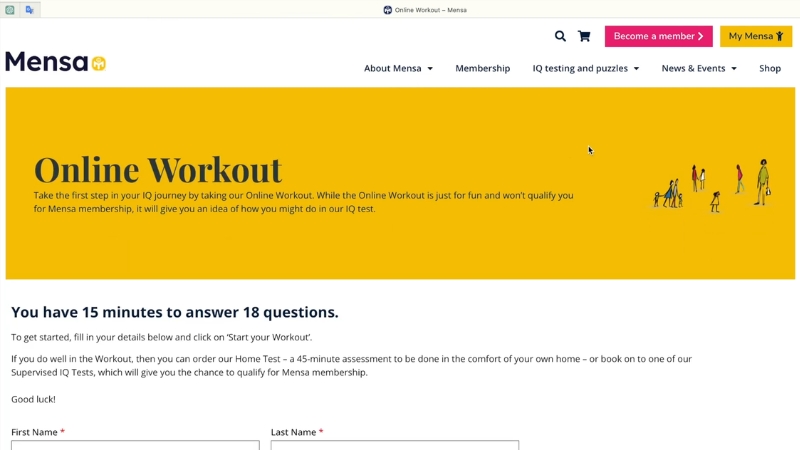
If you want the strongest online pick in 2026, start here. British Mensa says the assessment uses two adaptive tests, one focused on fluid reasoning through nonverbal diagrammatic items and one focused on verbal intelligence through vocabulary.
The questions adjust in difficulty as you answer, which is a major step up from many fixed-form internet quizzes. British Mensa also states that a score at or above the 98th percentile can qualify for membership.
That alone puts it in a different category from most online IQ content. Many sites offer a score. Very few tie the result to a recognized admission standard. For readers who want a practical answer to “Which online IQ quiz matters most?”, the UK Mensa option has the clearest case.
Still, even here, common sense matters. A quiet room, a good device, and fresh concentration can shift the result. Fairness and validity in assessment depend heavily on administration conditions, access, and interpretation.
Why It Ranks First
The appeal is not only the brand name. It is the combination of adaptive design, dual-domain coverage, and real-world usefulness.
For anyone who wants more than entertainment, no other option on the list offers a clearer bridge between online curiosity and a recognized outcome.
2. Mensa Norway IQ Test
Mensa Norway has become a favorite for a reason. The test is free, visually clean, and focused on 35 pattern-based puzzles to be solved in 25 minutes.
The official page says it gives an indication of general cognitive ability with a score range from 85 to 145, with 100 as the population average. It also plainly says the test is not a substitute for professional intelligence testing by Mensa or licensed psychologists.
That honesty matters. Many quiz sites talk big and explain little. Mensa Norway tells users exactly what the tool is, what it is not, and how to take it in conditions that give the result a fair shot. The page even advises a distraction-free room and notes that there is no penalty for guessing.
For many people, the real advantage is the item style. Matrix puzzles reduce dependence on school knowledge and language, which can make them feel cleaner than word-heavy quizzes, especially for non-native English speakers.
Research on Raven-style matrix measures helps explain why formats like that remain central in cognitive testing.
3. American Mensa Practice Test
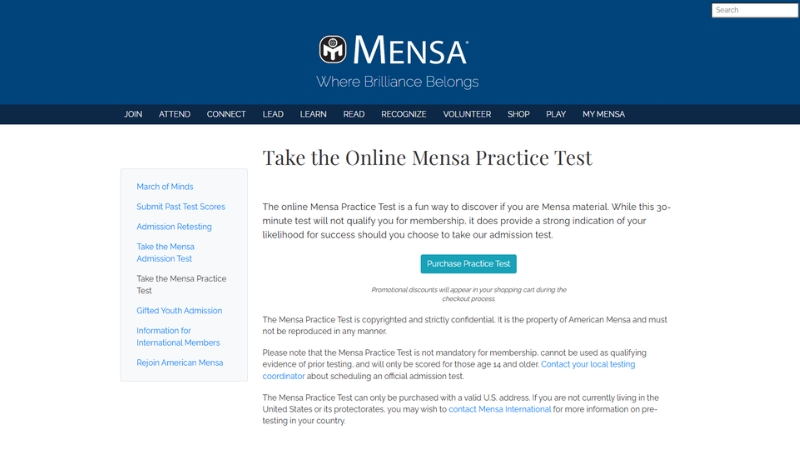
American Mensa takes a slightly different route. Rather than promising a neat IQ number, the site frames its practice test around a practical question: how likely are you to succeed on the official admission test?
The homepage says the practice test takes about 30 minutes and gives you a sense of your likelihood of success.
That framing is refreshingly grounded. A lot of users do not actually need a vanity score. They want to know whether paying for a real exam is worth it. For a U.S. audience, the American Mensa practice tool is one of the most useful ways to answer that without pretending to be more precise than it is.
American Mensa also makes clear elsewhere that full-scale accepted evidence for membership comes from complete, properly administered intelligence tests such as approved Wechsler measures, not casual online quizzes.
4. Mensa International IQ Challenge
View this post on Instagram
The Mensa International IQ Challenge is a strong free option for readers who want a clean, global starting point.
The official page says the challenge uses 35 puzzles in 25 minutes, and the items get progressively harder as you move through the set. It also notes that lower scorers may receive a message saying the score falls outside the range the test can currently measure.
A tougher scale can be useful. Plenty of online quizzes are padded so users leave feeling brilliant. The Mensa International version does the opposite.
It is happy to let the test feel difficult. That makes it better as a reality check, especially for readers who have already run through easier internet puzzle sites.
Mensa’s own FAQ also says the challenge is for practice and cannot be used to qualify for membership. Keep that in mind before treating the score like a formal credential.
5. Open-Source Psychometrics Full Scale IQ Test
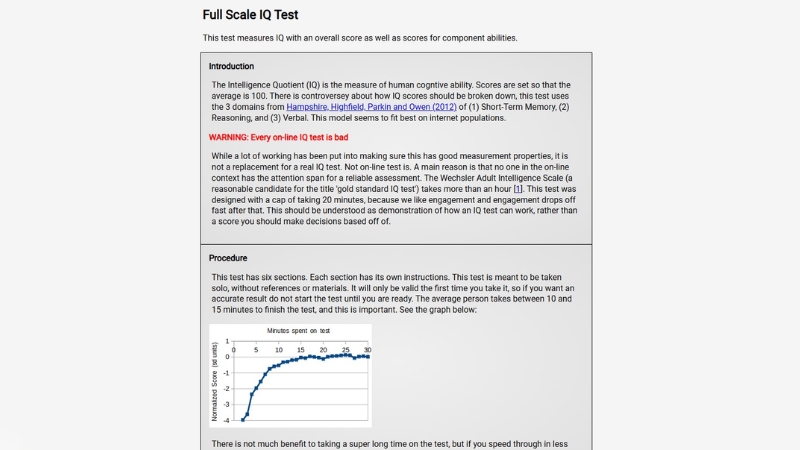
Among non-Mensa options, Open-Source Psychometrics deserves real credit for being unusually candid. The test says it measures IQ with an overall score and component abilities.
More importantly, the site includes a blunt warning: every online IQ test is bad compared with a real one, and the quiz should be treated as a demonstration rather than a result for major life decisions.
That kind of plain language is rare, and it makes the test more trustworthy, not less. The site says its structure draws on a model covering short-term memory, reasoning, and verbal ability, based on published research.
It also explains that the average internet user will finish in roughly 10 to 15 minutes, with a hard design cap to keep engagement from collapsing.
For readers who want more texture than one number, the full-scale psychometrics option is one of the best places to start. It gives a broader profile and does not pretend to be the final word.
Best Use Case
Use it when you want a rough ability profile and you are willing to accept the limits of an internet-administered tool. Skip it if you want an officially recognized result.
6. ICAR Sample Tests
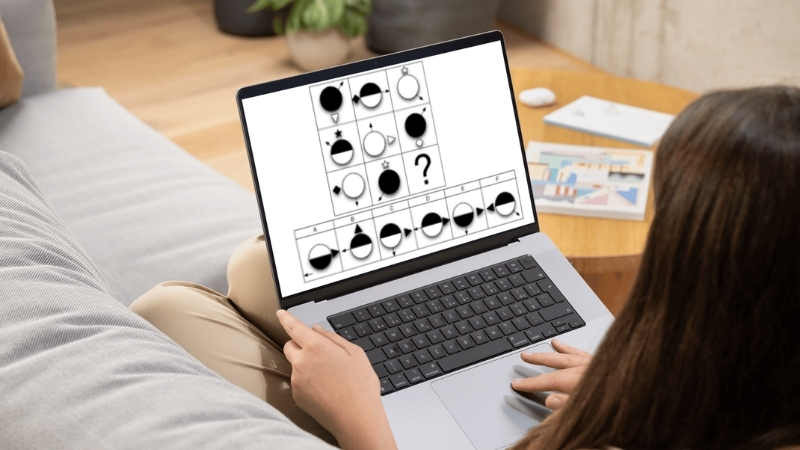
The International Cognitive Ability Resource, better known as ICAR, sits a little outside the usual consumer quiz market. The project describes itself as a public-domain assessment tool meant to support broader cognitive ability measurement in psychology, social science, and neuropsychological work.
Its sample tests are built on the open-source Concerto platform, developed at the Psychometrics Centre, University of Cambridge.
That makes ICAR especially appealing for readers who care about test design rather than entertainment polish. You will not get the glossy consumer experience of a commercial quiz funnel. What you do get is an item bank and testing framework tied to research culture.
A 2025 validation paper also described Raven-style matrices within ICAR-related assessment work as a nonverbal reasoning measure tied to fluid intelligence.
ICAR ranks below Mensa and Open-Source Psychometrics for ordinary readers because the interface and presentation are less approachable. Still, for academics, students, and anyone who wants a closer look at open cognitive testing materials, it is one of the strongest names on the board.
7. Mensa Sweden Provtest
Sweden’s Mensa provtest is a good short-form option when time is tight. The official page says it includes 24 items with a 10-minute time limit. After completion, users get an estimated IQ and placement relative to the general population.
The page also warns that results can be misleading if the test is taken more than once, and says the result is representative only for people over 18.
That is a lot of useful disclosure for a short quiz. The drawback is obvious: 10 minutes is a narrow window for any task that aims to say something about reasoning. Research on timed testing has repeatedly argued that time pressure can reduce validity and reliability for power-based tasks.
So why keep it on the list? Because a quick matrix check still has value when framed properly. Sweden’s version gives a fast snapshot, explains its limits, and does not bury the caveats in fine print.
8. Open-Source Psychometrics Vocabulary IQ Test
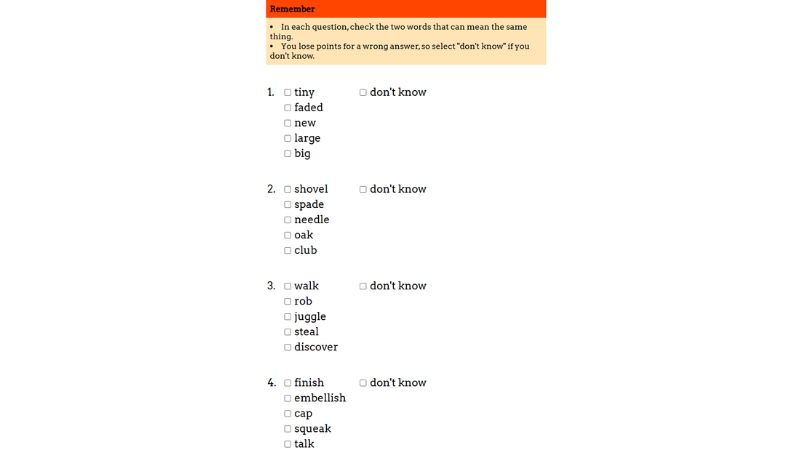
The vocabulary test from Open-Source Psychometrics is the best specialized verbal pick, with one major caution. The site says it gives results in the form of an IQ score, uses 45 questions, and penalizes wrong answers.
It also says outright that the quiz is not a full-scale IQ test and that vocabulary can be a poor measure for non-native English speakers or people with unusual educational backgrounds.
That warning is exactly why the quiz still belongs on the list. A verbal score can be useful, particularly for native speakers who want a narrow reading on one area of cognitive performance.
But vocabulary is heavily shaped by reading history, education, and language environment. In other words, a low score here may say more about language exposure than raw reasoning ability.
Use it as a side lens, not a headline verdict.
What Online IQ Quizzes Can Actually Tell You
A good online IQ quiz can give you a signal. It can show whether you handle pattern reasoning comfortably, whether verbal tasks feel easy or effortful, and whether a formal test might be worth booking. It can also be fun, and there is nothing wrong with that.
What it cannot do, at least in most cases, is replace a properly standardized assessment. Broader guidance on psychological testing points to standardized procedures, controlled conditions, clinical judgment, and careful test selection as core parts of valid assessment.
Research on fairness adds another layer, stressing subgroup representation, access, bias reduction, and proper interpretation of scores for their intended use.
Timing is another issue. Many online quizzes are short because short quizzes keep people engaged. Yet evidence on time-limited testing shows that speed pressure can distort results, especially when the goal is to assess higher-level reasoning rather than simple rapid response.
How to Get a Better Result From Any Quiz
A few small choices can make your score more meaningful:
Several official pages on the list make similar points, either directly or indirectly, by warning against repeated attempts, language bias, distraction, or overinterpretation.
Summary
@mahadthementor Can you answer the IQ question at the end? 🤔 #college #student #school ♬ original sound – Mahad
The best IQ quizzes in 2026 are not the ones making the loudest promises. They are the ones that explain their limits, use solid item formats, and give you a result worth interpreting with care.
For context, many skills measured in such tests also play a role in academic paths like the most valuable business degrees, where analytical thinking and problem-solving carry real weight.
Start with Mensa UK, Mensa Norway, or Open-Source Psychometrics, depending on what you want from the experience. Then treat the result as a clue, not a label.